
Older city homes and newer suburbs across Jefferson and Shelby counties
Spray Foam Insulation in Birmingham, AL
Keep the summer heat and the humidity out of your attic, ducts and crawl space, with every area priced in writing.
- Free on-site estimates
- Written quote naming the foam, thickness and R-value for each area
- Moisture, leaks and termite access checked before anything gets covered
Built for 65 Days a Year Above 90 Degrees
Spray foam insulation in Birmingham is mostly a fight against heat and humidity. Wikipedia's climate figures for the city, drawn from 1991-2020 normals at the airport, show July highs averaging 91.0F, about 65 days a year at 90F or hotter, an average relative humidity of 70.4% and 56.62 inches of rain a year. Winters are short but real, with January lows averaging 34.9F. A house here needs insulation that keeps the attic heat out of the living space in summer, stops humid outdoor air from leaking in, and holds the furnace heat on the cold nights. We insulate and air seal Birmingham homes with open-cell and closed-cell spray foam where it pays, and blown-in insulation where that does the job for less.
What the Alabama code asks for
Alabama adopted the 2015 International Energy Conservation Code with state amendments, effective October 1, 2016, according to the Department of Energy's energy code status page. Jefferson, Shelby and St. Clair counties all fall in IECC Climate Zone 3A, the warm, humid zone. Alabama Power's summary of the amended code lists R-30 for ceilings, R-13 for walls and a mandatory blower door test showing less than 5 air changes per hour at 50 pascals for new homes. The amended code also deems R-20 of spray foam equivalent to the ceiling requirement in a semi-conditioned (sealed) attic. For existing houses, the Department of Energy recommends more: R-49 to R-60 for a Zone 3 attic with no insulation, and R-38 to R-49 added where 3 to 4 inches already cover the floor.
The houses we see in Birmingham
Birmingham was founded in 1871 by the Elyton Land Company in Jones Valley, at a rail crossing near the iron ore, coal and limestone that made it the Magic City. Its housing stock shows that age. Point2Homes' summary of the Census Bureau's 2019-2023 American Community Survey puts the city's median year built at 1965, with 18.3% of homes built in 1939 or earlier and roughly 43% built before 1960. Older houses here often have plaster walls with little or no insulation, raised floors over crawl spaces with open vents, and attics with a few inches of settled fill. The suburbs over the mountain tell a different story: Hoover's median year built is 1994 and Chelsea's is 2007, so we see more vaulted ceilings, bonus rooms over garages and ductwork running through hot attics.
Closed cell vs open cell foam
Open-cell foam is soft and light. It expands a lot, fills irregular cavities and stops air movement, but it lets some water vapor pass. HomeGuide lists it at about R-3.5 to R-3.7 per inch. Closed-cell foam is dense and rigid, about R-5 to R-7 per inch, and at normal thickness it works as a vapor retarder and does not soak up water. In the Birmingham area, open-cell is a common choice under the roof deck when an attic is sealed, and inside above-grade walls. Closed-cell is the usual pick for crawl space walls, rim joists, areas that can get wet and metal buildings. We name the foam for each area on the quote and explain why.
Attics and ductwork
In many Birmingham homes the air handler and ducts sit in the attic, where summer temperatures run far above the outdoor air. Two approaches work. One is to air seal the attic floor and add blown-in insulation to depth, leaving the attic vented. The other is attic encapsulation: spray foam on the underside of the roof deck and gable walls so the attic, ducts and equipment sit inside the insulated shell. Encapsulation costs more, but it brings the ductwork out of the heat and stops it from sweating. We look at your roof, your ducts and your budget and tell you which fits.
Crawl spaces, humidity and termites
With average humidity above 70%, a vented crawl space in Birmingham pulls in damp summer air that condenses on cool ducts, pipes and floor framing. Sealing the crawl space, laying a heavy vapor barrier and insulating the foundation walls turns it into a dry, semi-conditioned space. Termites matter here too. HUD's termite guidance places Alabama in TIP Zone 1, rated very heavy, so we leave an inspection gap where your pest control company needs one and never bury the sill or the foundation top under foam without a plan.
Picking spray foam insulation contractors
Whether you found us by searching spray foam insulation near me or through a friend, ask the same questions of every insulation company you call. What will they seal before they insulate? Which foam will they use in each area, at what thickness and R-value? How will they handle attic ventilation, combustion appliances and the termite inspection gap? How long should you stay out after spraying (HomeGuide says to plan on at least 24 hours)? Is the quote written area by area? Good insulation contractors answer all of that without hesitation, and our written quotes answer it before you ask.
Spray foam insulation cost
According to HomeGuide's 2026 guide, installed spray foam averages $1.50 to $5.00 per square foot: $1.50 to $3.50 for open-cell and $3.00 to $5.00 for closed-cell. HomeGuide puts an attic at $3,000 to $8,000, a crawl space at $2,000 to $4,000 and a whole house at $8,000 to $20,000, and notes that many installers set a minimum around $1,000 to $2,000. Blown-in insulation runs $1.00 to $2.80 per square foot in HomeGuide's blown-in guide. In older Birmingham houses, removing old, dirty insulation before new work is a common add-on that moves the total. Use those numbers for budgeting; the price on your written estimate is what you pay.
Paying for the work
Alabama Power's Smart Financing program, run through Regions, lists insulation and crawl space encapsulation among the upgrades it finances for single-family homes, and its page says anyone can apply, not only Alabama Power customers. Terms and participating installers are set by the program, so check its page for current details before you plan around it.
What We Do
Six kinds of insulation work, chosen area by area: foam where air and moisture are the problem, loose fill where depth is the cheaper answer.
Spray Foam Insulation
Open-cell or closed-cell foam, chosen for each surface, that insulates and stops air leaks in one step.
Learn more →Attic Encapsulation
Seal and insulate the roofline so the ducts and air handler in your attic stop working in summer heat.
Learn more →Crawl Space Encapsulation & Insulation
Close the vents, lay a heavy vapor barrier and insulate the walls so the crawl space stays dry.
Learn more →Blown-In Attic Insulation
Air seal the attic floor, then blow cellulose or fiberglass to a depth that fits Zone 3.
Learn more →Wall Insulation
Dense-pack or foam for finished walls, and full-cavity foam for new walls and additions.
Learn more →Insulation Removal & Replacement
Clear out wet, dirty or rodent-damaged insulation, seal what is underneath, and replace it properly.
Learn more →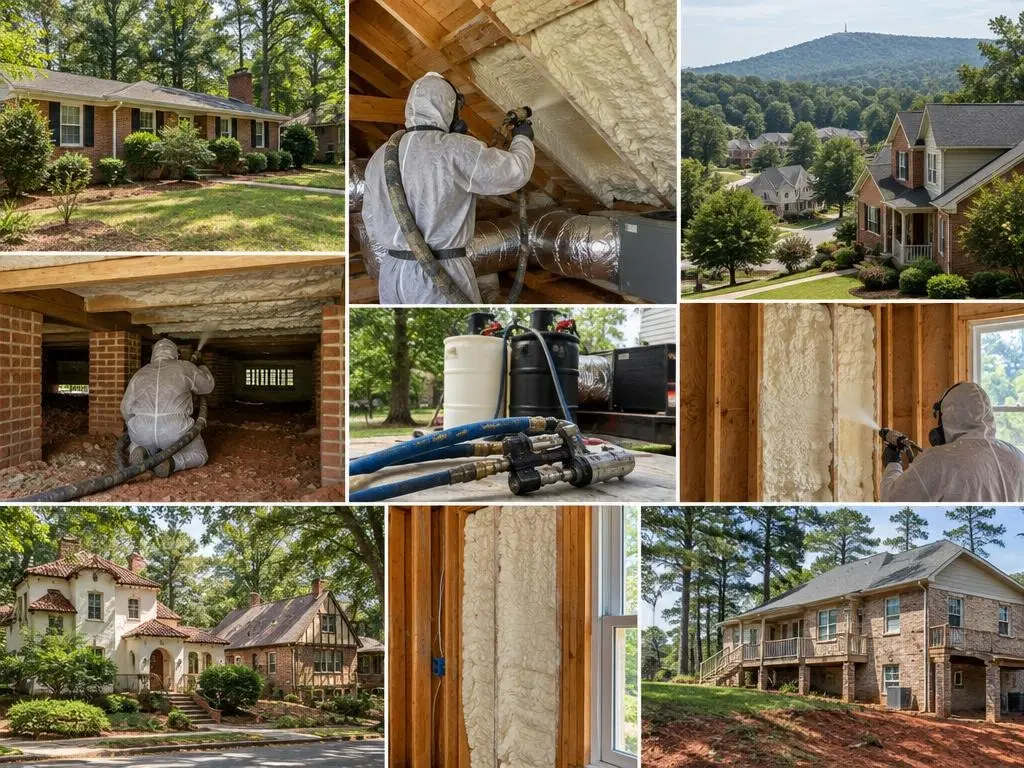
Why Homeowners Call Spray Foam Insulation Birmingham
We inspect before we price
Every quote follows a visit to the attic, crawl space or walls in question. Nothing is guessed over the phone.
Humidity is part of the plan
We check ducts, crawl spaces and roof decks for moisture before deciding between open-cell, closed-cell and loose fill.
Seal first, then insulate
Bypasses, top plates, flues, recessed lights and the attic hatch are sealed before new insulation hides them.
Every area on its own line
The written quote lists material, thickness, R-value and price for each area, so you can compare and choose.
Common Questions
How much does spray foam insulation cost in Birmingham?
National figures from HomeGuide put installed spray foam at $1.50 to $5.00 per square foot, with attics at $3,000 to $8,000 and whole houses at $8,000 to $20,000. Foam type, thickness, access and whether old insulation must come out change the number. We give you a written estimate after seeing the house, and that estimate is the price.
Which spray foam has the highest R-value?
Closed-cell foam, at roughly R-5 to R-7 per inch according to HomeGuide, compared with about R-3.5 to R-3.7 for open-cell. Higher R per inch does not always make it the right choice, though. Under a roof deck, open-cell at the right thickness often does the job for less, while closed-cell earns its cost in crawl spaces and anywhere moisture is a risk.
Can mold grow behind spray foam insulation?
Foam itself is not food for mold, but wood or drywall that stays wet can grow it, foam or not. Mold problems usually trace back to a roof leak, a plumbing leak or humid air reaching a cold surface. That is why we look for leaks before spraying and why crawl space and attic encapsulation in Birmingham includes controlling the humidity in that space, not just insulating it.
What R-value does Alabama require in the attic?
Alabama's amended 2015 energy code, as summarized by Alabama Power, lists R-30 for ceilings, and it treats R-20 of spray foam as equivalent in a sealed, semi-conditioned attic. For existing homes, the Department of Energy recommends R-49 to R-60 in a Zone 3 attic that has no insulation. Check with your city's building department on permits for your project.
Should I seal my attic or keep it vented?
If your ducts and air handler are in the attic, sealing it with foam on the roof deck usually makes the biggest difference in comfort and keeps the ducts from sweating. If the attic is empty of equipment, sealing the attic floor and blowing insulation to depth often costs less. We look at both and price them side by side when either would work.
How long do we need to leave the house after spraying?
HomeGuide advises staying out for at least 24 hours after spray foam is applied, and we plan jobs around that. Blown-in cellulose or fiberglass work does not require you to leave. We go over the timing for your job when we schedule it.
Where We Work
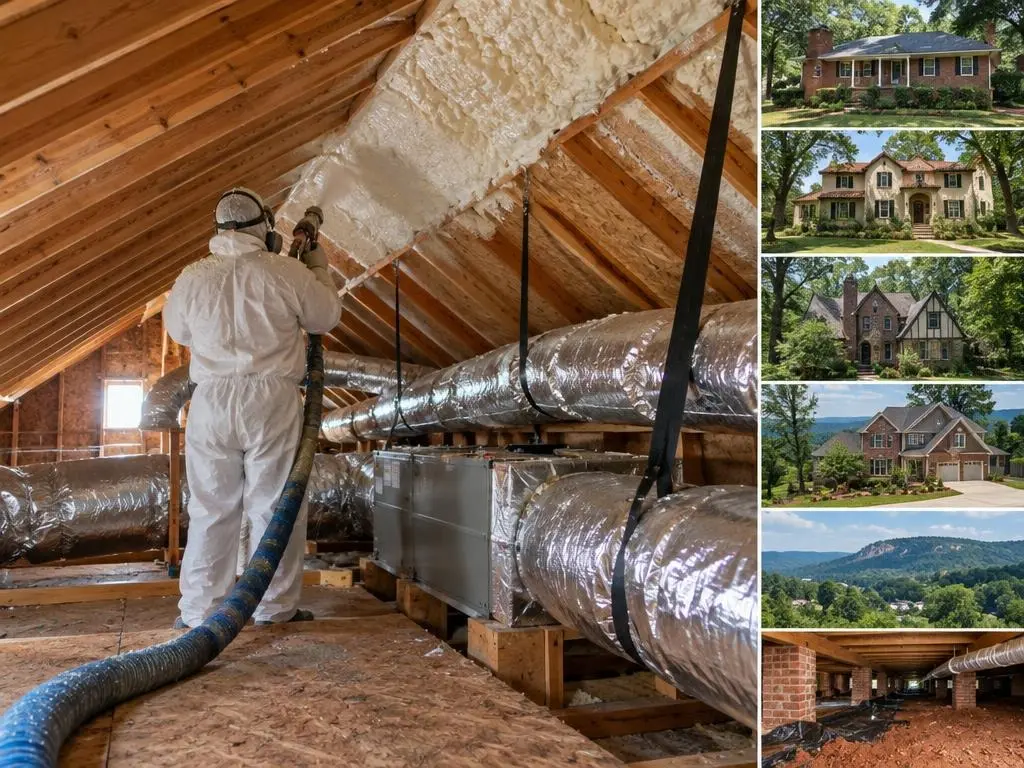
We work in Birmingham and the cities around it. Over the Mountain, that means Homewood, Mountain Brook, Vestavia Hills and Hoover, where houses range from 1920s Spanish Colonial Revival homes to 1990s subdivisions. South along I-65 and US 280 we cover Pelham, Alabaster, Helena, Chelsea and Calera, where most homes went up after 1990. East and north are Irondale, Leeds, Trussville, Moody, Center Point, Gardendale and Fultondale, and to the west are Bessemer, Hueytown and Pleasant Grove, old iron and coal towns with plenty of mid-century houses on crawl spaces. Each town page explains what is different about the housing there.
- Spray Foam Insulation in Birmingham, AL
- Spray Foam Insulation in Hoover, AL
- Spray Foam Insulation in Vestavia Hills, AL
- Spray Foam Insulation in Mountain Brook, AL
- Spray Foam Insulation in Homewood, AL
- Spray Foam Insulation in Trussville, AL
- Spray Foam Insulation in Bessemer, AL
- Spray Foam Insulation in Pelham, AL
- Spray Foam Insulation in Alabaster, AL
- Spray Foam Insulation in Helena, AL
- Spray Foam Insulation in Gardendale, AL
- Spray Foam Insulation in Center Point, AL
- Spray Foam Insulation in Irondale, AL
- Spray Foam Insulation in Leeds, AL
- Spray Foam Insulation in Chelsea, AL
- Spray Foam Insulation in Hueytown, AL
- Spray Foam Insulation in Fultondale, AL
- Spray Foam Insulation in Moody, AL
- Spray Foam Insulation in Calera, AL
- Spray Foam Insulation in Pleasant Grove, AL
Get a Spray Foam Insulation Estimate
Free on-site visit in Birmingham and nearby cities, with a written quote for each area.